By: Atty. Hendrequito T. Sebios, Jr.
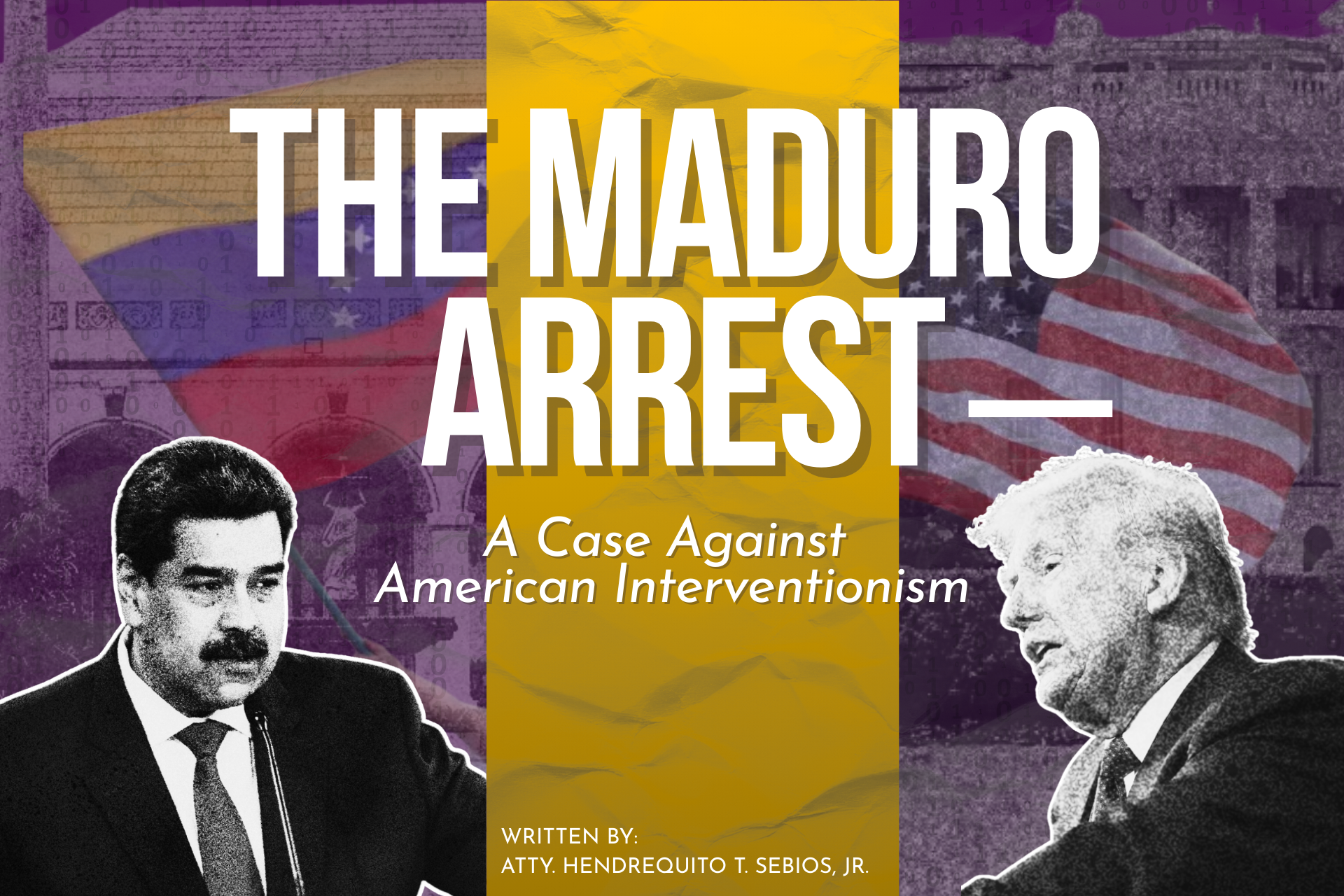
The President and high-ranking officials of the Government of the United States of America (US) argue that the capture and detention of the sitting Venezuelan President, Nicolás Maduro, and his wife, Cilia Flores, on charges of narco‑terrorism and drug trafficking is not a conventional military invasion but a legitimate law enforcement action to apprehend fugitives from US justice.
The US insists that the attack is necessary and consistent to American security interests and does not violate the principle of sovereign equality of States enshrined under Article 2(1) of the United Nations (UN) Charter and the territorial integrity and political independence of Venezuela guaranteed under Article 2(4) of the same UN Charter.
They also argue that US intervention was necessary to remove Maduro as a usurper who, according to the US, lost the recent elections in Venezuela. This intervention is supposedly justified under the Monroe Doctrine (1823)—a US demand for respect of its sphere of interest in the Western Hemisphere (which includes Venezuela), and the Roosevelt Corollary (1905)—the extension of the Monroe Doctrine where the US insists on its “international police power” to “curb chronic wrongdoings”. Basically, US intervention on the affairs of other States is justified under all circumstances where they supposedly see some “chronic wrongdoings”. The world is directed to agree and comply.
In its National Security Strategy published in November of 2025, the US declared that non-interventionism in the affairs of other nations is America’s preferred policy. But it quickly adds that rigid adherence to non-interventionism is not possible in view of the numerous interests of the US. It has therefore reinterpreted the case for non-interventionism articulated by America’s founders in their own Declaration of Independence into a mere predisposition to non-interventionism. The predisposition to non-interventionism should now only set a high bar for the US on what would constitute a justified intervention to the affairs of other sovereign States.
The U.S. concept of “justified intervention” aligns with long-standing American policies such as the Monroe Doctrine and the Roosevelt Corollary, and constitutes a key element of its broader hegemonic strategy.
But as a UN Member State, the US should act not only in accordance with its own laws and policies but also with the UN Charter. Article 2(4) of the UN Charter provides that all Members shall refrain in their international relations from the threat or use of force against the territorial integrity or political independence of any State, or in any other manner inconsistent with the purposes of the UN.
Article 2(4) of the UN Charter is very important as the foremost purpose for the creation of the UN is to prevent the similar events which led to World War II from happening again. The International Court of Justice (ICJ) even signified the importance of Article 2(4) in its judgment in the case of Democratic Republic of Congo v. Uganda by stating that it is the cornerstone of the United Nations Charter.
The recognized exceptions to the prohibition against the threat or use of force is if the threat or use of force against another State is (1) as a legitimate act of individual or collective self-defense under Article 51 of the UN Charter or (2) with the authorization of the UN Security Council.
UN Security Council authorization is absent in this case.
This leaves self-defense under Article 51 as the only potentially viable international law justification for the US acts against Venezuela. But except perhaps, from Israel, there will almost certainly be a scarcity of support if the US invokes Article 51 under the circumstances.
The consensus among the vast majority of UN Member States is that an armed attack is a necessary precondition to the exercise of the right of self-defense. They argue that since the wording of Article 51 is clear and unambiguous, there is no need for interpretation, only application of the law. This view is consistent with the wealth of jurisprudence from the ICJ on Article 2(4) and Article 51 and is almost the unanimous considered opinion of various legal luminaries on international law in the Philippines and abroad.
If this view is to be applied in interpreting the liability of the US under the present circumstances, it needs only be inquired whether narco-terrorism and drug trafficking allegedly perpetrated by Maduro and his government against the US are armed attacks under international law.
The obvious answer is in the negative.
But to entertain the possibility of the point being raised by the US, let us now determine what an armed attack is.
Rephrased and summarized for convenience, Max Planck Encyclopedia of Public International Law and relevant decisions of the ICJ indicate that an armed attack may be defined as the qualified use of force carried out by a state through a state organ, qualified or determined based on the criteria of scale (the attack’s target, means, and duration) and effects (the attack’s damage caused to human life and property) of the use of force, whether by military or non-military means, either through the traditional kinetic uses of force or through operations limited to the cyber realm.
This definition seems to lend credence to a possible argument that narco-terrorism and drug trafficking are armed attacks. But it does not. Simply put, narco-terrorism and drug trafficking are not kinetic uses of force as they do not involve the physical force or motion to cause damage through guns, bullets, or explosives. And although the cyber realm may be used for the spread and trafficking of illegal drugs, the mere sale of a contraband online does not constitute a cyber-attack as the physical drugs must first be physically delivered to its potential user for use and actually used for their undesirable effects to show.
The wealth of jurisprudence of the ICJ also does not indicate that narco-terrorism and drug trafficking constitutes armed attacks. There is also no support to such an argument from both Philippine jurisprudence or American jurisprudence.
Be that as it may, there is no stare decisis in international law and unique and bizarre arguments may still be raised by the US in defense of its intervention in Venezuela.
Afterall, the US and some of its allies are of a differing view from most States on the interpretation of Article 51. Many who belong to the minority with the US believe that the right of self-defense can also be exercised in certain circumstances where an armed attack is imminent but has not yet occurred. There is no clear evidence, however, of an impending attack by Venezuela on the US or on any US ally.
The US took its interpretation of Article 51 further in its “unwilling or unable” doctrine which allows for the use of force against non-state actors on the territory of another state simply if that state is either unwilling or unable to prevent attacks originating from its territory. This will also not make sense as an argument for the US as the ones abducted in Venezuela are not members of a drug cartel but a sitting president and his wife.
Even assuming arguendo that Maduro and other actors within the Venezuelan government actively participated in illicit drug related activities, Article 51 will not be triggered as illicit drug related activities are acts which do not amount to an armed attack, as already discussed.
Between the US and Venezuela, it is actually Venezuela which can now invoke Article 51 and authorize operations against legitimate US targets.
A very important question must also be answered. Can the US be held accountable? Politically and militarily, no. But the US can be sued before the ICJ. Sadly, though, any judgment against the US will almost likely end up unenforced.
The UN Security Council practically cannot authorize military strikes against the US as it is a permanent member of the same Security Council. All resolutions that the Security Council may hypothetically attempt to pass against the US would be an exercise in futility. Venezuela, on its own, has very limited response options as it is, economically and military, leagues weaker than the US. Venezuelan allies like Iran, China, and Russia cannot be trusted to protect Venezuelan interests as they are either embroiled in conflicts of their own or have no significant military muscle to flex in the Americas. Economic sanctions from Iran, China, and Russia may also cost them more than the US or have little effect.
Under international law, Maduro, his wife, and all citizens of the world are entitled to exercise civil, political, economic, social, and cultural rights regardless of race, color, sex, language, religion or social origin. But it seems that to the US, one can only exercise these rights in accordance with American interests. Just today, the US President issued another statement. This time, Mexico and Columbia were urged to “get their acts together”, as if they and their leaders are potentially the next targets of US intervention. Warnings were also issued against India, Iran, and Greenland.
The acts of the US against Venezuela are hostile not only against Venezuela. It sets a dangerous precedent directly harming the geopolitical stance of the Philippines in the West Philippine Sea as the US has seemingly marked its stamp of approval to violations of international law and may embolden China in its own hegemonic ambitions in Asia. The Philippines must, therefore, get its act together, too, by working non-stop on building a credible deterrence against any military or economic aggression.